Palworld Jormuntide Ignis Breeding Guide: Best Combos for 2026
Getting your first Jormuntide Ignis isn’t difficult once you know the correct breeding combination, but many players waste hours pairing the wrong Pals and burning through valuable Cake before realizing their mistake. If you’re looking for the fastest way to breed this powerful Dragon/Fire Pal, this Palworld Jormuntide Ignis breeding guide covers everything you need to know.
You’ll learn the exact breeding combo, the requirements for your Breeding Farm, how to breed better passive skills, common mistakes to avoid, and whether breeding is actually faster than catching one in the wild.
How to Get Jormuntide Ignis in Palworld by Breeding (Quick Answer)
Breed Blazehowl and Jormuntide in a Tech Level 19 Breeding Farm, stocked with Cake, and you’ll get a Jormuntide Ignis egg directly. No multi-generation chain required. That’s the entire trick. If you already own a Jormuntide Ignis, pairing two of them together also produces another one, which becomes useful once you’re trying to lock in good passives rather than just getting your first copy.
If you’re the type who just wants the combo and nothing else, you now have it. Everyone else, keep reading, because there’s nuance that will genuinely save you time.
Why This Combo Actually Matters
Here’s the thing about breeding Jormuntide Ignis that trips people up: this isn’t a “combine two random dragons and hope” situation like a lot of mid-tier Pals. Jormuntide Ignis has a genuinely unique cross-species combo, and if you don’t know it going in, you’ll waste hours doing exactly what a lot of new players do the first time. They throw random Dragon and Fire types together and watch the game spit out Jormuntide, the normal Water/Dragon one, over and over instead.
It also carries the Stormbringer Lava Dragon partner skill, which is worth knowing before you commit a saddle slot to it. If your goal is a mount rather than a base worker, that skill alone is usually the deciding factor.
Use our Palworld Calculator to breed Jormuntide Ignis with the ideal work passives for maximum efficiency.
Palworld Breeding Combos for Jormuntide Ignis, Broken Down
Let’s get concrete, because vague guides are the whole reason you’re here.
Parents needed: one Blazehowl, one Jormuntide. Gender doesn’t matter for this particular pairing, it works either way.
Where to find them if you don’t have them yet: Blazehowl shows up wild roughly levels 35 to 67 across the main island, so it isn’t a rare catch by any stretch. Jormuntide is the harder get. It spawns around level 80, mostly in the World Tree region. If you’re under-leveled for that area, you’ll want a strong team or a plan to weaken and catch rather than a straight fight.
What you need at your base: a Breeding Farm at Tech Level 19, and Cake in the attached chest. One Cake gets consumed per egg produced, so if you’re planning to run this more than once, and you probably will since passive skills are random, stock up before you start rather than after your first hatch.
So does that mean you’re locked into farming Blazehowl and Jormuntide forever? Not exactly. Once you’ve got one Jormuntide Ignis in hand, pairing it with a second Jormuntide Ignis will also reliably produce another one. That’s your endgame loop for passive skill fishing: breed two Ignis together repeatedly until the RNG hands you a build worth keeping.
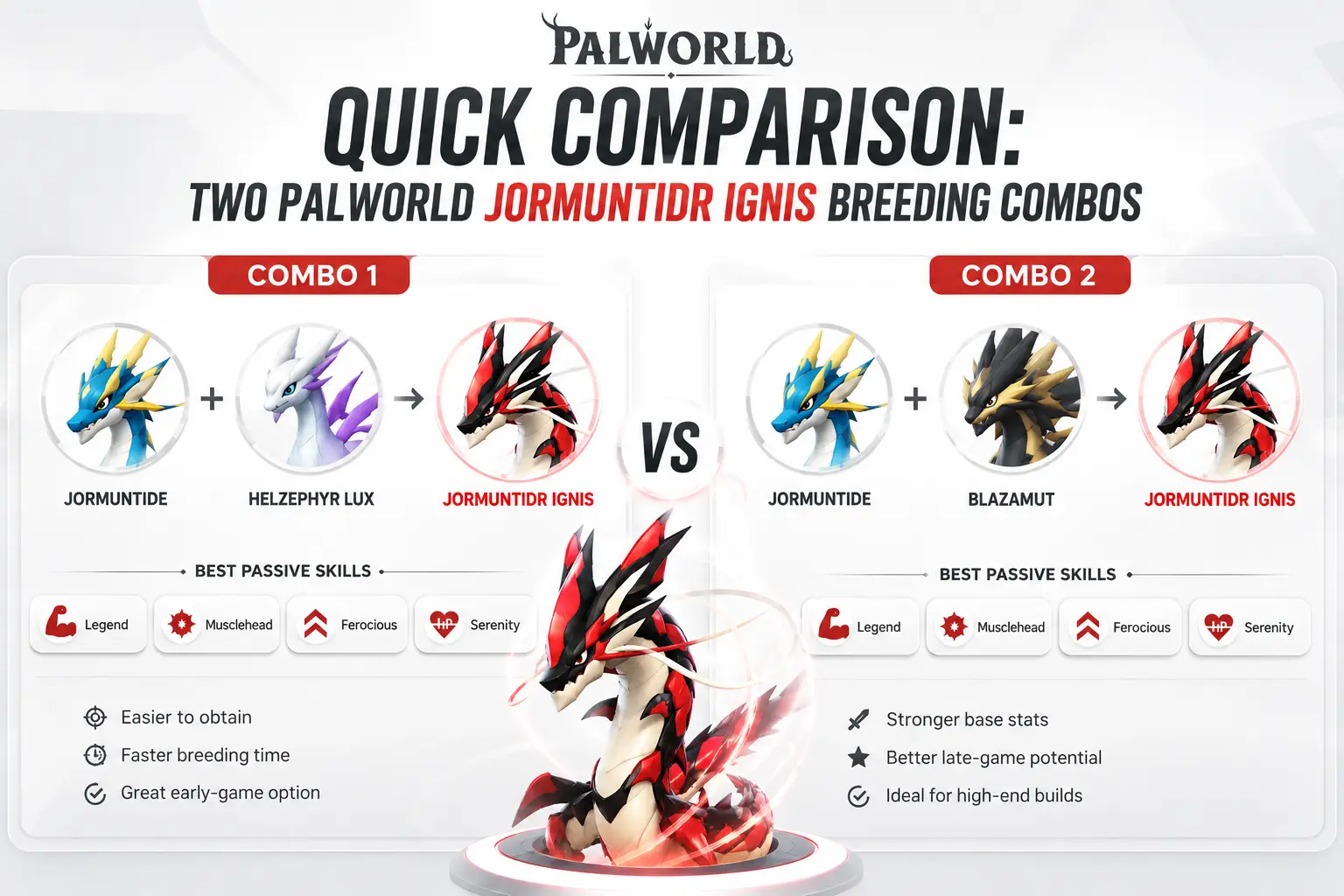
Quick Comparison: Two Palworld Jormuntide Ignis Breeding Combos
| Path |
Parents |
Best For |
| First-time route |
Blazehowl + Jormuntide |
Getting your very first Jormuntide Ignis |
| Passive-fishing route |
Jormuntide Ignis + Jormuntide Ignis |
Refining passives once you already have one |
The Decision Tree: Which Route Should You Take?
Answer honestly, because plenty of players waste a full evening by skipping this step. Most questions about breeding Jormuntide Ignis come down to one of these three situations.
• Don’t own a Jormuntide Ignis yet? Go catch or breed a Blazehowl and a Jormuntide. That’s your only realistic path in, and it’s the starting point for breeding Jormuntide Ignis from scratch.
• Already have one, but its passives are garbage? Skip the Blazehowl route entirely. Breed your existing Ignis with a second one (buy, catch, or breed a spare) and cycle eggs until you get something better.
• Just want a “good enough” one fast and don’t care about optimizing passives? Honestly, consider just catching one wild instead. It spawns at level 66 and up in Mt. Obsidian, and if your combat team can handle that level range, it might genuinely be faster than running two separate breeding chains back to back.
Where I'd Push Back on the “Just Breed a Ton” Advice
A lot of guides tell you to just spam eggs until you get lucky. That’s technically true, but it’s lazy advice, and it’s worth being a little more honest about the breeding combos players actually rely on for Jormuntide Ignis.
Passive inheritance in Palworld isn’t a coin flip, it’s weighted. A child inherits somewhere between one and four passives from its parents, with the odds dropping off at roughly 40/30/20/10 depending on how many get passed down, and then it can additionally roll zero to three brand new random passives at that same declining rate. What that means practically: parent passive quality matters far more than raw egg quantity. If you’re breeding two Jormuntide Ignis with mediocre passives, you’ll mostly just get mediocre offspring, no matter how many eggs you crack open.
A smarter approach, the one worth adopting after burning through way too much cake early on, is keeping a dedicated “breeding pair” separate from the “working” Jormuntide Ignis that actually sits on your base or team. The breeding pair only gets swapped out when a hatch produces something with strictly better passives than what’s currently sitting in that slot. It’s slow and unglamorous, but it actually works, and it stops the temptation to keep every mediocre hatch just because it took resources to make.
Common Mistakes Worth Avoiding
A few things trip people up more than they should when breeding Jormuntide Ignis, and most of them are avoidable with a five-minute check beforehand.
The biggest one is starting the breeding chain before the Breeding Farm is actually unlocked at Tech Level 19. Players assume they’ve hit that tier because they’ve logged enough hours, then discover they’re two or three levels short right when they try to place the farm.
The second is running out of Cake mid-chain. One Cake per egg sounds trivial until you’re six or seven eggs into a fishing session and suddenly your farm sits idle while you fly back to restock flour, eggs, and milk.
The third, and this one’s sneaky, is mixing up Jormuntide with Jormuntide Ignis when shopping the in-game Pal list or a breeding calculator. They look nearly identical in name and share a base model, so a rushed click can send you down the wrong chain entirely. Double-checking both names before confirming the pairing is the single easiest way to keep breeding Jormuntide Ignis on track.
Checklist Before Breeding Jormuntide Ignis in Palworld
Run through this before committing resources:
☐ Breeding Farm built and at Tech Level 19
☐ Cake stocked in the attached chest, more than one, trust the process
☐ Blazehowl and Jormuntide caught, or an existing Jormuntide Ignis pair ready
☐ Egg Incubator free and available for the hatch
☐ A spot on your roster or in storage for the result
If every box is checked, the setup is genuinely ready. If the Jormuntide specifically is missing, that’s almost always the bottleneck, so handle that before touching anything else.
Try This Right Now
Before closing this tab, go check your Tech Tree level. Seriously, open it up. A lot of players assume they’ve unlocked Tech Level 19 Breeding Farms simply because they’ve been playing for hours, only to reach the farm menu and realize they’re two levels short. It saves a wasted trip, and it’s the one prerequisite every Jormuntide Ignis breeding attempt trips over first.
FAQ
Can I skip Jormuntide entirely and use something else?
No. For the direct, single-cross route, Jormuntide is a required parent. There’s no shortcut that avoids catching or breeding one first.
Does gender matter for the Blazehowl and Jormuntide pairing?
No, either gender combination works for this cross.
Is it faster to just catch Jormuntide Ignis in the wild instead of breeding?
Sometimes, yes. It spawns wild at level 66 to 67, concentrated around Mt. Obsidian. If your team can handle that fight comfortably, catching one might genuinely beat the breeding chain, though you won’t have any control over its passives that way.
Will breeding two Jormuntide Ignis together ever fail and give me a regular Jormuntide instead?
No. That specific same-species pairing reliably produces another Jormuntide Ignis. The mix-up mentioned earlier only happens when unrelated Dragon or Fire-type Pals get used instead of the actual combo.
How many eggs should I realistically expect to hatch before getting good passives?
There’s no fixed number, since it’s weighted RNG rather than a guaranteed curve, but budgeting for somewhere in the range of six to twelve eggs for a genuinely strong passive spread is a reasonable expectation based on how the inheritance odds are structured.
Still have questions? Visit our Contact Us page, and we’ll be happy to help.